참조문헌
- First-principles study of a topological phase transition induced by image potential states in MXenes
- Gigantic negative magnetoresistance in the bulk of a disordered topological insulator
- Temperature dependent crossover between positive and negative magnetoresistance in graphene nanocrystallines embedded carbon film, Dong Ding et al,
- Correlation-driven organic 3D topologicalinsulator with relativistic fermions
- Spin-Momentum Locking Induced Anisotropic Magnetoresistance in Monolayer WTe2
- First-principles study of a topological phase transition induced by image potential states in MXenes
- Enhancing the magnetism of 2D carbide MXene $Ti_3 C_2T_x$ by $H_2$ annealing
- Tuning the Magnetic Properties of Two-Dimensional MXenes by Chemical Etching
- Spin-dependent scattering induced negative magnetoresistance in topological insulator Bi2Te3 nanowires
- Linear magnetoresistance in mosaic-like bilayer graphene
- https://pubs.acs.org/doi/10.1021/acs.nanolett.1c02329
0. Introduction
그래핀에서의 스핀 수송현상이 발견된 이래로, 2D 물질에 대한 스핀트로닉스 연구가 큰 관심을 끌고 있다. TMDs, TMHs 등의 물질 들에서 2D 강자성이 나타날 것으로 예상되고 있으며, TMDs 에서의 SOT 연구도 활발히 진행되고 있다. 새로이 명명된 MXene이라는 물질은 TMCs(Transition Metal Carbides/Carbonitrides)로 구성되며, 강하게 결합되어 있는 3차원 화합물로 부터 metal sheet를 선택적으로 extraction하여 만들 수 있다.
이 MXene은 MAX phases의 전이 금속에서, '$\mathrm{M}$' layer에 샌드위치 되어있는 '$\mathrm{A}$' layer를 추출함으로써 구할 수 있다. 일반적으로 MAX phases 전이금속은 $\mathrm{M}_{n+1} \mathrm{A} \mathrm{X}_n$의 화학 공식으로 쓸 수 있으며, 여기서 $\mathrm{M}$은 앞전이금속(early transition metal), $\mathrm{A}$ A-group 원소(대부분이 group IIIA, IVA 이다), 마지막으로 $\mathrm{X}$는 $\mathrm{C}$, 또는 $\mathrm{N}$을 나타낸다. 이렇게 $\mathrm{A}$를 제거한 금속 물질은 graph'ene'과 비슷한 전기적 특성을 가지며, 이를 비유적으로 본따 MXene이라는 이름이 명명됐다.
일반적으로 MXene의 intrinsic property는 MAX phase 속 transition metal이 결정한다. 그러므로, 대부분의 보고된 magnetic MXene은 $\mathrm{Cr}$, $\mathrm{V}$, $\mathrm{Mn}$, $\mathrm{Mo}$, $\mathrm{Fe}$, $\mathrm{Co}$, 그리고 $\mathrm{Ni}$ 등의 magnetic metal elements를 가지고 있다. 하지만, nonmagnetic transition metal을 기반으로 만들어진 MXene 역시 자성을 띄는 것으로 예상되어지며, 이는 defects, 서로 다른 surface terminating group, synthetic procedures가 그원인이 될 수 있다.
Shien et al에 따르면 MXene의 intra layer는 기본적으로 antiferromagnetic의 성질을 가지지만, 바깥에 붙어있는 terminations의 행동들이 out-of-plane vibration을 보이고, 이것이 edge, surface 부근에서 약한 ferromagnetic effect를 만들어낸다는 것이다. 또한, MAX phase와 비교하여 Fermi energy근처의 density of states에서 상당한 양의 전기적 DOS를 만들어내는 것을 발견했다. 이는 부서진 Al-Ti bonds로부터 발생한 Ti-3d states의 resdistribution 때문이다. 이는 결과적으로 Fermi level 근처에서 Ti-Ti bonding을 강화시키는 결과를 내놓는다.
The Ti atoms on external sheet possess ferromagnetic ordering
of spins whereas they connect antiferromagnetically with
opposite Ti-sheet producing mixed ferromagnetic (FM)-antiferromagnetic
(AFM) phases. The Ti atoms in the internal
portion of the sheets, which do not have any bonding previously
with aluminium or currently with the O or F, remain
non-magnetic making no contribution towards this anomalous
magnetic origin.
자화vs온도 곡선, ferromagnetic hysteresis loop, 그리고 exchange-bias의 존재는, 낮은 온도에서 ferromagnetic phase와 antiferromagnetic phase의 공존을 나타내며, 이는 Ti 원자의 방향이 MXene sheet의 outer position을 향함으로써 나타나는 ferromagnetic orientation과, MXene sheet 내부의 intralayer relation이 anti-ferromagnetic을 유지하기 때문이다. 또한 높은 온도에서 FM phase의 영향이 감소하는 이유로는, 온도 상승에 의한 spin-misalignement로 인한 것이 유력하다.
termination을 제거함으로써 (O-) 낮은 온도에서 발생하는 ferromagnetic order를 증가시킴(Bohr magneton이 커짐)
not saturated up to the highest magnetic field we have
measured, due to the paramagnetic background.
1. Anomaly cusp near 55 K
$\mathrm{Ti}_3 \mathrm{C}_2 \mathrm{T}_x$ (여기서 $\mathrm{T}_x$는 Mxene sheet의 surface termination($\mathrm{O}^{2-}$, $\mathrm{OH}^-$, 그리고 $\mathrm{F}^-$))의 자성 특성은 SQUID를 통해 분석 됐으며, etching의 정도는 XRD를 이용해 결정됐다. 우리는 PM-AFM phase transition이 두개의 synthesis 기법 각각에서 서로 다른 Neel temperature에 대해 모두 일어남을 발견 했다. 이는 다시 말해 aluminum content가 magnetic transition을 중재함을 의미한다.
O, –OH, –F, and –Cl are typical MXene surface terminators
an aqueous etching of the Al from the MAX phase (Ti3AlC2) does not leave bare Ti layers and produces functional groups (Tx), resulting in Ti3C2Tx
MXene surfaces are terminated by mixed –O, –F and –OH functional groups as a result of the chemical etching production process. These functional groups are known to be randomly distributed over the surfaces, with limited experimental control over their composition.
Generally, HCl/LiF or HF etching permits a change in the relative amounts of –OH, =O, and –F-terminated groups on the MXene surface
The magnetic property of the resulting Ti3C2Tx MXene was analyzed using a superconducting quantum interference device (SQUID) and the extent of etching was determined by using X- ray diffraction (XRD).We observed a paramagneticantiferromagnetic (PM-AFM) phase transition in samples generated by both synthesis techniques that occurred at different Neel temperatures, indicating that the aluminum content mediates the magnetic transition.
To investigate how the extent of etching affected the magnetic properties, a SQUID
VSM was used to measure the magnetic moment as a function of an applied magnetic field
and temperature in an applied magnetic field of 1 kOe.
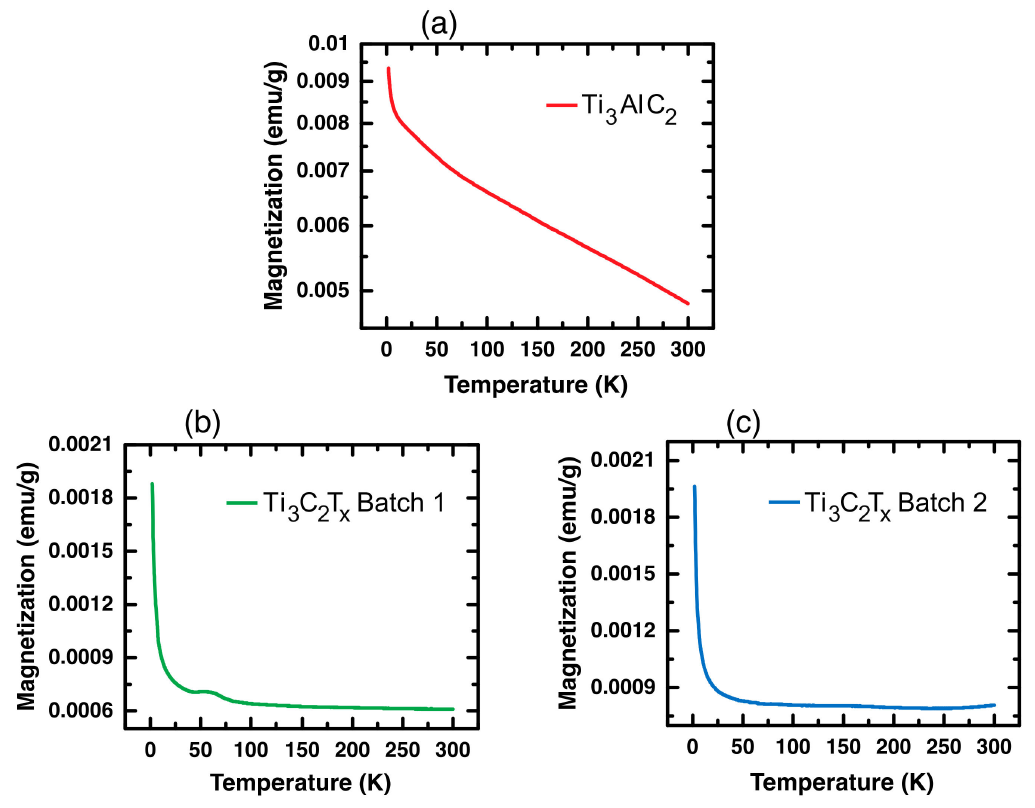
위 그래프를 보면, 높은 온도에서는 paramagnetic 한 성질을 보이지만, 온도가 내려갈 수록 매우 복잡한 현상이 나타남을 알 수 있다. Yoon et al. 에서 보인 결과와 비슷하게, 높은 온도에서는 온도와 무관환 자성 현상을 보이며 우리가 제작한 MXene이 Pauli paramagnets임을 유추할 수 있다. Yoon et al.은 낮은 온도에서의 현상이 temperature dependent Curie term과 유사하다고 발표하였지만, 우리는 다른 의견을 제시하고자 한다.
위 그래프를 보면 70 K 부근에서 antiferromagnetic-like cusp가 존재하는데, 이는 paramagnetic-antiferromagnetic(PM-AFM) phase transition이 나타남을 알려준다. Al을 더 철저히 제거한 Batch 2의 경우, cusp는 더 높은 Neel temperature로 이동한다. 흥미롭게도, 2K에서 에칭된 두 샘플 batch 모두 $Ti_3 Al C2$에 비해 magnetization의 크기가 1/5 밖에 되지 않았다. 이러한 결과는 서로 다른 magnetic behavior, 또는 magnetic phase transition이 etching되지 않고 남아있는 Al에 의한 것임을 짐작 할 수 있다. 특히, etching되지 않은 $\mathrm{Ti}_3 \mathrm{Al} \mathrm{C}_2$의 FM behavior는 Al에 의해 중재되며, 더욱이 near-surface region에 위치한 Al에 의해 중재된다. Etching이 진행 된 이후, $\mathrm{Ti}_3 \mathrm{Al} \mathrm{C}_2$는 $\mathrm{Ti}_3 \mathrm{C}_2 \mathrm{T}_x$로 변화하며 더욱 적은 양의 $\mathrm{Al}$을 갖게되며, 여기서 $\mathrm{Al}^{3+}$는 $\mathrm{Ti}_3 \mathrm{C}_2 \mathrm{T}_x$ MXene에서 복잡한 PM-AFM 행동을 유발하는 self-dopant로서 행동한다. 이 설명은 최근 보고된 $\mathrm{La}^{3+}$-doped $\mathrm{Ti}_3 \mathrm{C}_2 \mathrm{T}_x$(여기서 $\mathrm{La}^{3+}$ ion들은 MXene 표면에 흡착된다.) 에서 발견되는 AFM 행동과도 일치한다.
. These results indicated that different magnetic behavior and/or a magnetic phase transition might be influenced by the
presence of unetched Al. In particular, it appeared that the FM behavior in the unetched Ti3AlC2 was mediated by Al and more specifically Al in the near-surface region. After etching, Ti3AlC2 transformed to Ti3C2Tx with a much smaller amount of Al where Al3+ acted as a self-dopant causing complex PM-AFM behavior in the Ti3C2Tx MXene.
We observed a paramagneticantiferromagnetic (PM-AFM) phase transition in samples generated by both synthesis
techniques that occurred at different Néel temperatures, indicating that the aluminum content mediates the magnetic transition.
MXenes, a family of two-dimensional transition metal carbides and nitrides, have various tunable physical and chemical properties. Their diverse prospective applications in electronics and energy storage devices have triggered great interests in science and technology. MXenes can be functionalized by different surface terminations. Some O- and F-functionalized MXenes monolayers have been predicted to be topological insulators (TIs).


The interplay between negative and positive magnetoresistance can be understood in terms of the competition between dephasing and spin-orbit scattering time scales.
4. Two sates near T_C
5. B^n (n~0.x~1.x)
The curves are smooth and both
ZFC-FC branches almost coincide for Ti3C2Tx, whereas the curves of r-
Ti3C2Tx show some anomaly and the ZFC-FC branches slightly bifurcate
below 140 K. Such an anomaly and a slight bifurcation of the M vs. T
curve observed for r-Ti3C2Tx could be attributed to the changes in the
surface terminations of r-Ti3C2Tx with respect to Ti3C2Tx and changes in
the magnetic behavior of the sample below 140 K. Furthermore, a larger
value of magnetization observed for r-Ti3C2Tx as compared to that of
Ti3C2Tx for the same applied field of 0.1 T indicates that the The MReffect of graphenebased
material was considered to arise from edge states, which was regarded as main sources of the intervalley scattering thus causing restoration of weak localization (WL).
It was confirmed by many works that introducing more edge states of graphene, such as creating zig-zag edges and defects, can result in occurrence of prominent MR behavior.
With a high electron density at the Fermi level, MXene monolayers are predicted to be metallic.[1][49][50][51][52] In MAX phases, N(EF) is mostly M 3d orbitals, and the valence states below EF are composed of two sub-bands. One, sub-band A, made of hybridized Ti 3d-Al 3p orbitals, is near EF, and another, sub-band B, −10 to −3 eV below EF which is due to hybridized Ti 3d-C 2p and Ti 3d-Al 3s orbitals. Said differently, sub-band A is the source of Ti-Al bonds, while sub-band B is the source of Ti-C bond. Removing A layers causes the Ti 3d states to be redistributed from missing Ti-Al bonds to delocalized Ti-Ti metallic bond states near the Fermi energy in Ti2, therefore N(EF) is 2.5–4.5 times higher for MXenes than MAX phases.[1] Experimentally, the predicted higher N(EF) for MXenes has not been shown to lead to higher resistivities than the corresponding MAX phases. The energy positions of the O 2p (~6 eV) and the F 2p (~9 eV) bands from the Fermi level of Ti2CTx and Ti3C2Tx both depend on the adsorption sites and the bond lengths to the termination species.[53] Significant changes in the Ti-O/F coordination are observed with increasing temperature in the heat treatment.[54]
Only MXenes without surface terminations are predicted to be magnetic. Cr2C, Cr2N, and Ta3C2 are predicted to be ferromagnetic; Ti3C2 and Ti3N2 are predicted to be anti-ferromagnetic. None of these magnetic properties have yet been demonstrated experimentally.[1]
MXenes - Wikipedia
From Wikipedia, the free encyclopedia Class of two-dimensional inorganic compounds In materials science, MXenes are a class of two-dimensional inorganic compounds, that consist of atomically thin layers of transition metal carbides, nitrides, or carbonitri
en.wikipedia.org
Superconducting materials at room temperature are highly in demand for supercomputing and quantum computing purposes. Topological materials, most often topological insulators (TIs), are also found to conduct like superconductors at their certain regions. In TI, edges and surfaces are conducting, however their bulk is insulating. They are protected with time-reversal symmetry and have effective Spin-Orbit Interaction (SOI). Among several other terminated MXenes, M′xMy″Xene oxide (for x=2 and y=1, 2) has been theoretically found to be stable and has topological insulating property. Our WIEN2k calculation shows more band gap after SOI than the calculation made by M. Khazaei et al. 2015. M′xMy″Xene is a MXene with ordered double transition metals M′ and M″ derived from their parent M′xMy″AXene, where A is an A block element and X is a carbide, nitride, or carbonitride, following the structural composition Mn+1Xn for n=1, 2, or 3. The structure and composition of the parent-phase etched and delaminated ordered double transition metal layered carbide have been studied with the help of X-ray diffraction, scanning electron microscopy, transmission electron microscopy, and high-resolution transmission electron microscopy, and were found to be stable. Oxidation of M′xMy″Xene for experimental verification was another challenge for the selective adsorption of oxygen atoms required on the surface and to preserve bulk under high temperatures. Ablation plasma thrust oxidation adopted in a pulsed laser deposition chamber was successful in such oxidation. The resultant oxide was tested under angle-resolved photoemission spectroscopy (ARPES) and found to be topologically nontrivial. Its electrical, electronic, and magnetic properties are controlled by intercalations and terminations. In this chapter, we are trying to summarize the topologically trivial terminated MXenes and their derivations including our recent research work. 참조문헌
'Spintronics > Topological Insulator' 카테고리의 다른 글
| Magnetoresistance in Topological Insulator (0) | 2024.05.30 |
|---|---|
| Dirac Materials (0) | 2024.02.19 |
| Spin Momentum Locking (SML) (0) | 2024.02.14 |
| Weak Localization(WL)& Weak Anti-Loacalization(WAL) (1) | 2024.02.06 |
| (작성중) 위상부도체 (Topological insulator) (0) | 2021.05.24 |


댓글