5. Magnetoresistance in Topological Insulator
Hall Voltage in Topological Insulator
The nonlinear Hall result is likely the consequence of the presence of two channels of carriers in TIs, one from bulk and the other from the surface state [17, 32, 38].
5.1. Negative Magnetoresistance (NMR) in low temperature
NMR was observed in magnetic materials and Anderson localized 2D electron gas. 다양한 물리적 현상들이 NMR의 원인으로 지목되고 있으며, 대표적으로 아래의 원인들이 거론된다.
- dephasing과 spin-orbit scattering time 사이의 경쟁
- $\mathrm{Ga}^+$ ion milling, contamination에 의해 유도되는 강력한 localization
- Electron hopping transport
- Charge puddle formation
- Spin accumulated localized regions
현재까지, 다양한 NMR의 발견이 B-field가 TI에 수직, 또는 수평으로 작용할 때 보고됐다.
- Bi2Se3 박막 : crossover between WL and WAL of bulk electrons
- (Bi_x Sb_1-x)2Te3 : TSS에서 energy gap을 열면서 Berry phase가 변화하고, 이것이 WL과 WAL을 낮은 B-Field에서 경쟁시킨
- (Bi_x Sb_1-x)2Te3 박막: disorder-induced Anderson localization
- Sn-doped Bi2Te3 polycrystalline film, Bi2(Te0.4Se0.6)3 film : bulk states에서의 WL effect
- Bi2Se3 nanoribbons: TSS의 spin-dependent scattering과 Zeeman energy에 의한 surface Dirac cone deformation
- BiSbTeS2 nanoflake: disorder induced enhancement of defect states density from Ar+ ion milling
- TlBi0.15Sb0.85Te2: disordered bulk속 charge puddle의 형성
- Epitaxial Bi2Se3 박막: scattering mehcanism
- Bi2Se(3-y)Sy: Non-trivial bulk conduction, sulphur doping에 의한 electron puddle의 형성
온도가 상승함에 따라 NMR의 경향이 감소하는 것은 다시 말해 TSS와 B-field에 의한 spin polarization의 방향과 연관되는 양자역학적 특성이 온도 의존성을 가지며존재함을 암시한다.
2.1. Coulomb blockade effect
Negative MR의 주요 후보로서, Coulomb blockade effect가 있다. 온도가 올라감에 따라, 열적으로 활성화된 전자 터널링에 의해 증가하는 conductance가 Fermi level과 localized states 사이 근처에서 발생한다. 아래 그래프를 보면, 온도가 늘어남에 따라 ferromagnetic moment가 감소하는데, 이는 열적 교란에 의해 magnetic order가 억제되는 것을 암시한다.
Spin-dependent Coulomb blockade effect 때문에, GNC 박막의 resistivity는 전도전자(dominated by magnetic moment orientation varied from random to order in a magnetic field)의 낮은 scattering rate와 함께 낮아진다. ...
그러므로, 큰 negative MR은 lager GN들 사이에서의 높은 hopping probability에 의한 결과일 수도 있다. GN의 potential은 이들이 전자들을 얻을 때마다 $\Delta E$씩 증가한다. 이는 hopping을 하는 전도전자가 GN에 들어가기 위해 넘어야 하는 potential barreir를 증가시키게 된다. 다시 말해, electron tunneling probability는 potential barrier 와 연관된다. $\Delta E$는 GN의 크기에 반비례 하며 아래와 같이 나타낼 수 있다.
$\Delta E = \cfrac{e^2}{2\pi \epsilon_0 \epsilon R}$
2.2. Disorder-induced Localization of electron states
2.3. VRH transport
2.4. Formation of charge puddles
2.5. Ion-milling enhanced defect density in the material
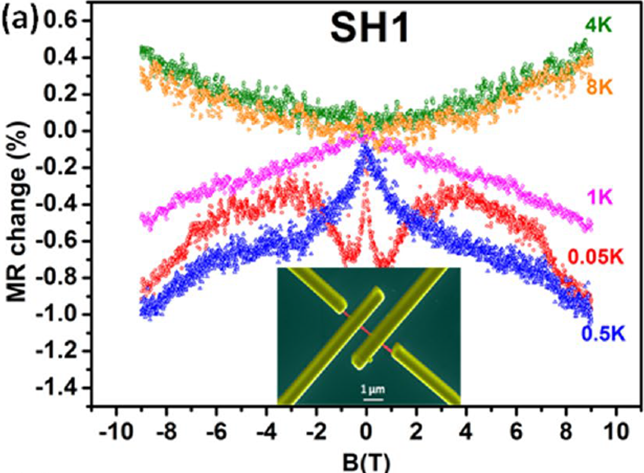
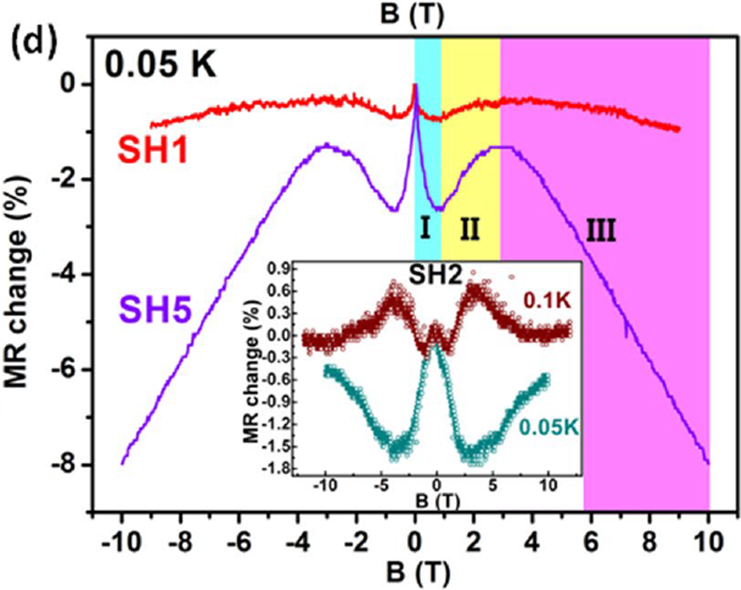
온도에 따라 MR이 NMR과 PMR을 왔다갔다하는 현상은 이전에는 WL, WAL effect에 의한 것으로 알려졌다. 왜냐하면 이러한 quantum inteference effects는 주로 낮은 온도에서 발생할 가능성이 높으며, 온도가 높아짐에 따라 사라지기 때문이다.
일반적으로, 두개의 time scale이 강력한 spin-momentum locking을 가지는 TI의 contuctivity, 또는 MR에 대한 quantum correction을 설명하기 위해 사용된다.
- electron dephasing time ($\tau_\phi$)
- spin-orbit scattering time ($\tau_\mathrm{SO}$)
Regime-1의 경우, $\tau_\mathrm{SO}$> $\tau_\phi$ 이며, 빈번한 spin-flip을 유발하는 spin-orbit scattering이 이 영역에서는 약함을 의미한다. 이는 B-Field가 증가함에 따라 물질의 저항을 감소시키며 NMR의 결과를 도출한다.
Regime-3에서는 매우 작은, 또는 무시할만한 spin-flips이 유발되며, 저항에 매우 큰 감소를 유발한다. 이는 large NMR (WL effect)라 불리며, 대체적으로 큰 linearly decreasing MR을 보인다.
B-field는 TSS의 spin-polarization 방향에 수직하게 변화한다. B-field와 spin-polarization의 정렬을 유발하는 spin-flips는 TSS에 의한 강력한 in-plane perpendicular spin-momentum locking에 의해 방해되므로, $B_{||} || I$ 방향은 spin-orbit scattering을 감소시키지 않고 B-field가 증가함에 따라 PMR이 예상된다. 그러므로, 이러한 방향을 가짐에도 NMR이 발생하는 것은 추가적인 물리적 메커니즘이 존재함을 암시하며, 높은 $\tau_\mathrm{SO}$를 의미한다.
이전의 연구들은 disorder에 의해 유도된 electronic states의 localization이 다양한 물질 속 NMR을 유발하는데 결정적인 역할을 한다고 설명했다. 이론적으로 conduction이 quantum diffusion을 통해 발생하는 WL regime($k l_e \gg 1$, 여기서 $k$=wave vector, $l_e$=mean free path) 내에서는 B-field가 electronic wave-function의 phase shift를 유발하여 backscattering probabilities를 억제함으로써 NMR을 유발한다고 한다. 반면에 conduction이 localized states사이의 quantum jump(variable-range-hopping(VRH))를 통해 발생하는, 강력한 localization regime(Anderson localization, $k l_e < 1 $)에서는, B-field에 의한 dephasing은 hopping process에 수반되는 다양한 elastic scattering paths 사이의 inteference를 감소시켜 NMR을 유발한다.
$Bi_2 Se_3$의 surface에 위치하는 전자의 큰 Lande factor(g~50)에 의해, Zeeman energy $B_{||}$에 의한 Zeeman energy는 Dirac cone을 deform시키고, TSS에 대해 spin-polarization의 정도를 약화시킨다. 또한, $Bi_2 Se_3$속에서 $Se_2$ atom 한개를 Bi atom이 대체하는 것을 이를 anti-site defect라 하는데, 이에 의한 spin-up과 spin-down의 DOS에 asymmetry가 system 속 local magnetic moments를 발생시킨다. 이로 인해 local magnetic moments에 대한 surface electron의 spin-dependent scattering이 발생하여 NMR을 야기한다.

해당 연구에서는 극저온(T < 2 K)속 $Bi_2 Te_3$ nanowire에서 큰 NMR이 발견된 것에 대한 내용으로 이루어져있다. NMR의 온도 의존성은 어떠한 양자역학적 현상이 근원에 있음을 암시한다. 온도가 올라감에 따라 MR이 PMR로 바뀌는 현상이 관측됐다.

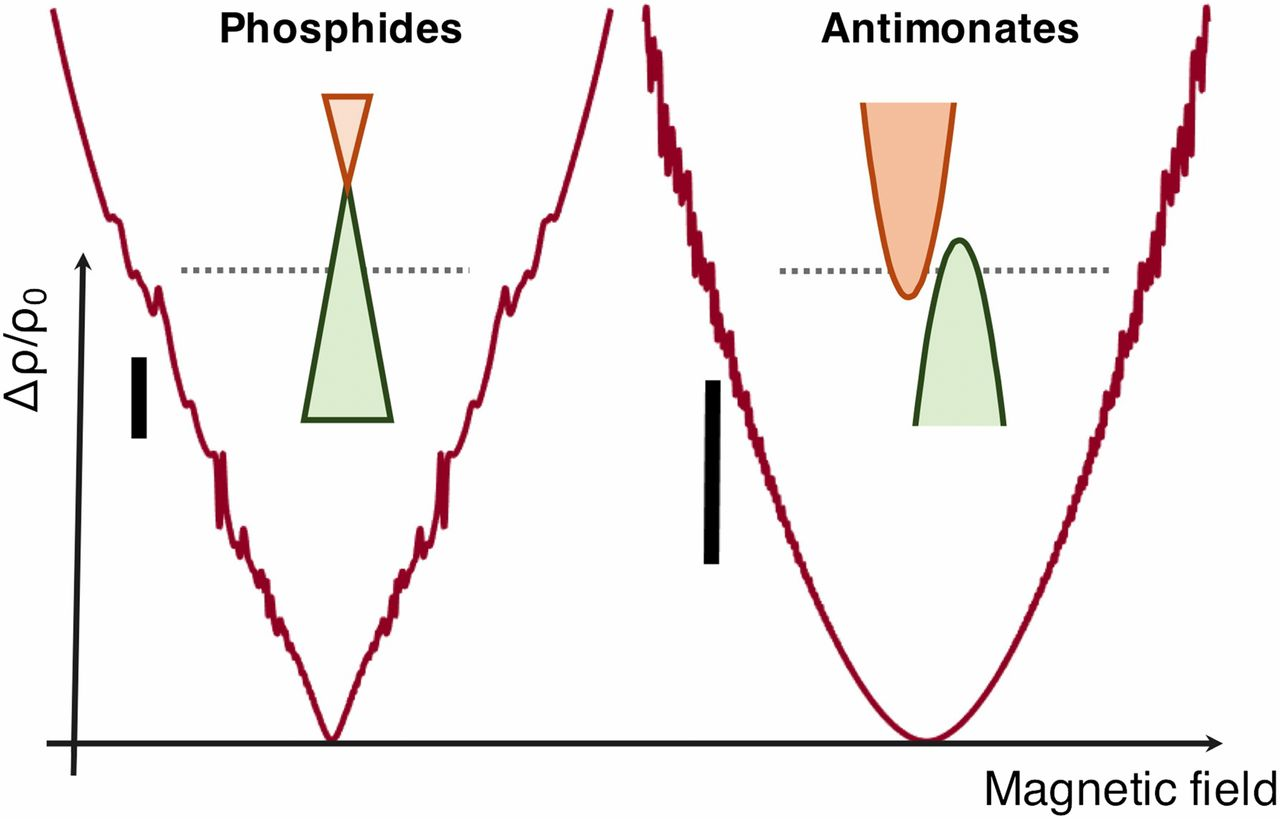
Large negative MR is usually related to magnetism, but the chiral anomaly in Weyl semimetals is a rare exception.
(a) Negative Magnetoresistance
The negative magnetoresistance measured for carbon materials consisting of turbostratic crystallites cannot be explained by the usual energy band scheme, conduction carriers of single holes, since single holes cannot be deflected by application of magnetic fields because of the Hall field.
Negative magnetoresistance can appear when the carrier density increases with application of a magnetic field. This explanation was proposed by Bright [21,22] and was an extension of the theory originally developed by Yazawa [23], with carrier-density increase resulting from the unique structure and spacing of the Landau levels in two-dimensional graphite, ie, carbon materials with turbostratic crystallites [24].
Negative magnetoresistance can also be explained by a weak localization effect. According to Bayot et al. [25,26], the weak localization effect is generally a low-temperature effect and occurs for disorganized materials when the probability of elastic scattering of carriers by static lattice defects is much larger than that for the temperature-dependent inelastic scattering processes due to carrier–phonon and carrier–carrier interactions. It can be demonstrated that the constructive interference of the elastically scattered partial carrier waves occurs in the backward direction, leading to an enhanced backscattering probability. This effect gives rise to a slight increase in the electrical resistivity with decreasing temperature, which is the prominent feature of the weak localization effect. Since the magnetic field tends to suppress the phase coherence of the backscattered waves, it destroys the weak localization effect. The observed magnetoresistance for the materials is negative and its absolute value increases as the temperature decreases. Liquid nitrogen temperature may be near the upper limit temperature for the weak localization effect.
The surface states of a three-dimensional topological insulator are composed of an odd number of two-dimensional gapless Dirac cones, which has a helical spin structure in momentum space, giving rise to a π Berry phase when an electron moves adiabatically around the Fermi surface. The π Berry phase can lead to the absence of backscattering, and further delocalization of the surface electrons.
Physics and Fundamental Theory
ㅡㅡㅡㅡㅡㅡㅡㅡㅡㅡㅡㅡㅡㅡㅡㅡㅡㅡㅡㅡㅡㅡㅡㅡㅡㅡㅡㅡㅡㅡㅡㅡㅡㅡㅡㅡㅡㅡㅡㅡㅡㅡㅡㅡㅡㅡㅡㅡ
를 할 수 있는데
Weak localization and weak anti-localization are quantum interference effects in quantum transport in a disordered electron system
낮은 온도에서, 반도체는 저항이 매우 증가하는 현상을 보인다. 이는 weak locailization라 불리는 효과와 연관 된다.
Weak locailization은 disordered medium 속에서 전자 파동함수의 interference와 관련이 있다.
이 interference는 자기장에 의해 없어지며, wave function의 phase를 바꿔주며, negative magnetoresistance를 유도한다. Semimagnetic 반도체의 경우, 이 disorder의 대부분은 magnetic ions들의 스핀과 연관되며, 자기장에 의해 영향을 받고 negative MR, 또는 positive MR의 결과를 내놓는다.

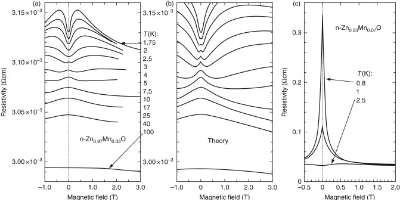
Figure 21. Experimental magnetoresistivity of n-Zn0.97Mn0.03 O (a) and corresponding model calculation (b), as well as experimental magnetoresistivity of n-Zn0.93Mn0.07 O (c). Reproduced with permission from Andrearczyk T, Jaroszynski J, Grabecki G, Dietl T, Fukumura T, and Kawasaki M (2005) Spin-related magnetoresistance of n-type ZnO:Al and Zn1 − x/Mnx/O:Al thin films. Physical Review B: Condensed Matter and Materials Physics 72: 121309-1–121309-4. Copyright 2005 by the American Physical Society.
In some semimagnetic samples, a strong resistance increase was observed at low temperatures (of order of 1 K), and quickly suppressed by magnetic field above 1 T (Figure 21(c)). This increase cannot be explained within the weak localization model; it may originate from formation of BMPs, which are known to be destroyed by magnetic field.
ㅡㅡㅡㅡㅡㅡㅡㅡㅡㅡㅡㅡㅡㅡㅡㅡㅡㅡㅡㅡㅡㅡㅡㅡㅡㅡㅡㅡㅡㅡㅡㅡㅡㅡㅡㅡㅡㅡㅡㅡㅡㅡㅡㅡㅡㅡㅡㅡㅡㅡㅡㅡㅡ
'Spintronics > Topological Insulator' 카테고리의 다른 글
| Dirac Materials (0) | 2024.02.19 |
|---|---|
| Spin Momentum Locking (SML) (0) | 2024.02.14 |
| Weak Localization(WL)& Weak Anti-Loacalization(WAL) (1) | 2024.02.06 |
| MXene (0) | 2024.01.18 |
| (작성중) 위상부도체 (Topological insulator) (0) | 2021.05.24 |


댓글